


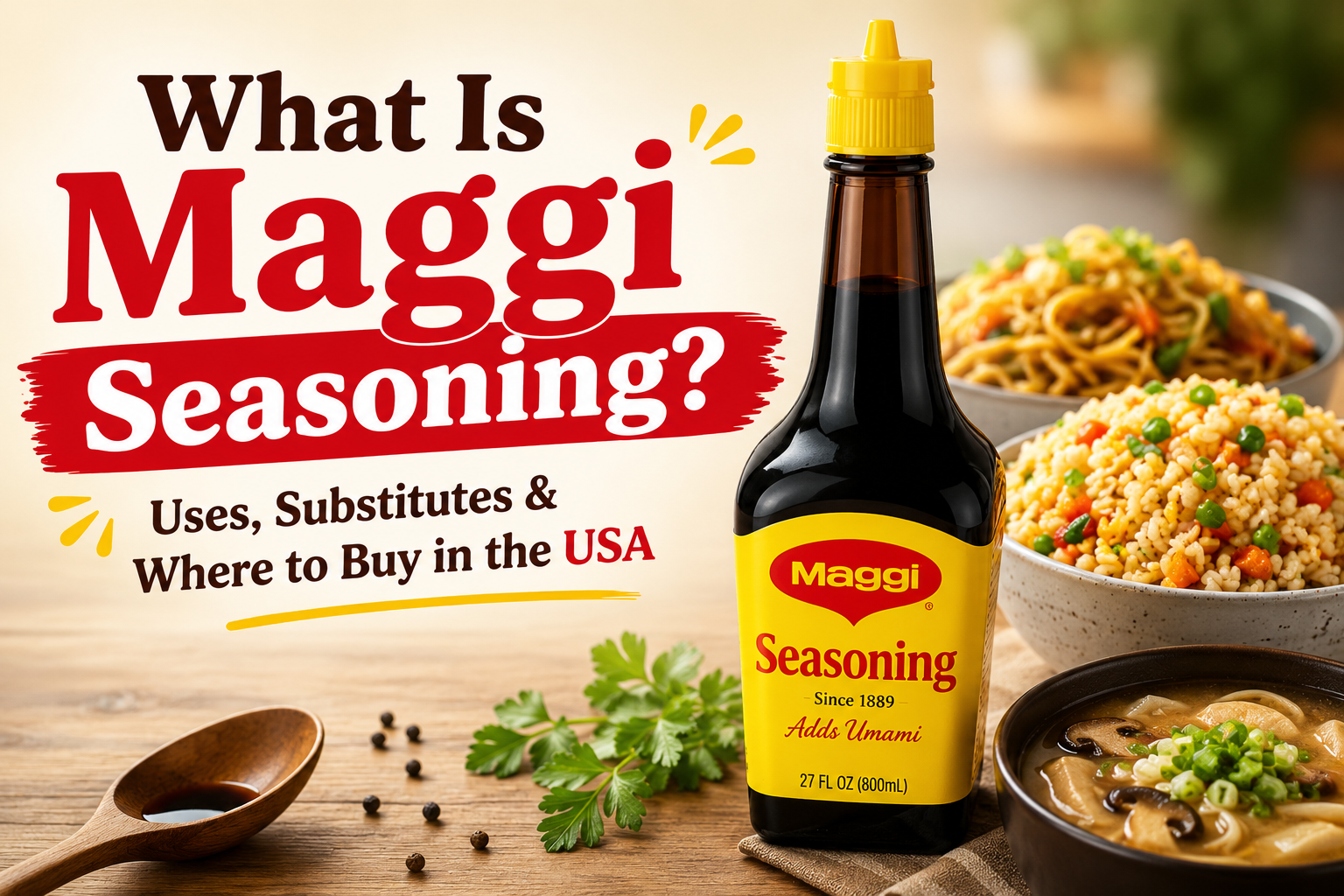
Maggi Seasoning is a concentrated liquid seasoning used to add a deep, savory umami flavor to food. It is commonly added in small amounts to soups, sauces, stir-fries, rice, noodles, marinades, vegetables, and meat dishes. The exact formula varies by country and product. The U.S. Maggi Seasoning listed by Nestlé Professional contains water, salt, wheat gluten, wheat flour, sugar, caramel color, acetic acid, and flavor-enhancing ingredients. It contains wheat, so it is not gluten-free.
Maggi Seasoning has a concentrated salty, savory, roasted, and slightly fermented flavor. A few drops can add noticeable depth without requiring a large amount of sauce.
Its flavor is often described as similar to a combination of soy sauce and other savory seasoning sauces, although Maggi has its own distinctive taste.
The ingredients depend on the specific Maggi product and country where it is sold. The U.S. Nestlé Professional version lists water, salt, wheat gluten, wheat flour, sugar, caramel color, acetic acid, wheat bran, and flavor enhancers among its ingredients.
Some international versions use hydrolyzed or fermented wheat protein along with salt, flavor enhancers, sugar, and other ingredients. For this reason, it's best to check the label of the specific bottle you're purchasing.
No. Although both are salty and provide umami, they are different products with different formulations and flavor profiles.
Soy sauce is traditionally made from fermented soybeans and wheat, while Maggi Seasoning is commonly based on fermented or hydrolyzed wheat protein in many formulations. Maggi also tends to have a more concentrated, roasted-savory character.
No. Maggi Seasoning is a liquid flavor enhancer, while Maggi noodles are an instant noodle product that typically comes with its own seasoning packet.
Maggi Seasoning can actually be used to add extra flavor to noodles, rice, stir-fries, soups, and many other dishes.
Add a few drops of Maggi Seasoning while cooking vegetables, noodles, chicken, tofu, or other stir-fried ingredients. It adds savory depth and helps bring the flavors together.
It works particularly well in fried rice and noodle dishes where you want a stronger umami flavor without adding a large amount of sauce.
Maggi Seasoning can give fried rice a deeper savory taste while adding a darker, more seasoned appearance. Add it gradually while tossing the rice with vegetables, eggs, meat, or tofu.
Because it is salty and concentrated, start with a small amount and adjust after tasting.
A few drops can transform plain noodles into a more flavorful dish. Combine it with vegetables, garlic, chili, sesame oil, or other seasonings for a quick meal.
It works especially well in stir-fried noodles because the concentrated seasoning coats the noodles evenly.
Maggi Seasoning can add extra umami to vegetable soups, meat soups, noodle soups, and broths. Nestlé Professional specifically recommends it for soups, sauces, salads, and vegetable dishes.
Add it toward the end of cooking and taste before adding additional salt.
Use Maggi Seasoning as part of a marinade for chicken, beef, seafood, tofu, or vegetables. Its savory flavor works well with garlic, ginger, black pepper, chili, and citrus.
Since it is already salty, reduce the amount of additional salt in the marinade.
A small amount of Maggi Seasoning can add depth to gravies, pan sauces, mushroom sauces, and other savory preparations. It is especially useful when a sauce tastes flat and needs another layer of umami.
Add it gradually rather than pouring in a large amount at once.
Maggi Seasoning can make roasted, steamed, sautéed, or stir-fried vegetables more savory. It pairs especially well with mushrooms, cabbage, broccoli, green beans, carrots, and mixed vegetables.
Nestlé Professional notes that it can add a roasted flavor to vegetable dishes without adding meat or meat juices.
Use a small amount in marinades, sauces, or during cooking to enhance the savory flavor of chicken, beef, pork, and seafood.
It can also be combined with garlic, ginger, pepper, and other spices to create a flavorful marinade.
Fried rice
Stir-fried noodles
Vegetable stir-fries
Soups and broths
Marinades
Gravies and sauces
Roasted vegetables
Meat dishes
Seafood dishes
Rice and noodle bowls
Maggi Seasoning is highly concentrated, so you usually don't need much. Nestlé Professional recommends using a few dashes to enhance dishes, and its product can be added at different stages of cooking.
A practical approach is to start with ½ to 1 teaspoon for a larger dish, taste it, and add more if needed. The amount will depend on the recipe, serving size, and how much salt is already present.
Soy sauce is one of the easiest alternatives because it provides both saltiness and umami. It works particularly well in fried rice, noodles, stir-fries, soups, and marinades.
The flavor isn't identical to Maggi, but it is widely available and can work as a convenient replacement.
Worcestershire sauce provides savory, fermented, slightly tangy flavor and can work well in sauces, marinades, soups, and meat dishes.
It has a stronger tangy character than Maggi, so start with a smaller amount and adjust according to taste.
Combining soy sauce and Worcestershire sauce can create a more complex substitute by combining saltiness, umami, sweetness, and fermented notes.
A common starting point is ½ teaspoon soy sauce plus ½ teaspoon Worcestershire sauce for 1 teaspoon of Maggi Seasoning, then adjust to taste.
Tamari can provide a rich savory flavor similar to soy sauce and works well in stir-fries, noodles, rice, and sauces.
However, don't automatically assume every tamari product is gluten-free. Check the product label if gluten avoidance is important.
Liquid aminos provide a concentrated savory flavor and can work in soups, vegetables, rice, and stir-fries.
They can be useful when you want an umami boost, although their flavor profile isn't exactly the same as Maggi.
Fish sauce delivers a powerful umami flavor and works especially well in Asian-inspired soups, stir-fries, marinades, and noodle dishes.
It has a distinct seafood character, so use less initially if you're trying to preserve the original flavor of your recipe.
Miso can add deep fermented umami flavor to soups, sauces, marinades, and vegetable dishes. Mix a small amount with water or another liquid before incorporating it into the recipe.
Because miso is thicker and has a different texture, it isn't a direct one-to-one replacement for liquid Maggi Seasoning.
| Feature | Maggi Seasoning | Soy Sauce |
|---|---|---|
| Flavor | Savory, concentrated, roasted | Salty, fermented, savory |
| Texture | Thin liquid | Thin to slightly thicker liquid |
| Main Base | Often wheat-based | Soybeans and wheat in many varieties |
| Color | Dark brown | Brown to very dark brown |
| Best For | Soups, rice, noodles, sauces | Stir-fries, sushi, marinades, sauces |
| Flavor Intensity | Highly concentrated | Varies by type |
Many Maggi Seasoning products are not gluten-free because they contain wheat or wheat-derived ingredients. The U.S. Nestlé Professional product specifically lists wheat gluten and wheat flour and states that it contains wheat.
However, Maggi products vary by market and formulation. Always check the ingredient and allergen information on the exact product before purchasing.
This depends on the specific product and country. Some liquid seasoning versions are suitable for vegetarians, while other Maggi seasoning products may contain animal-derived ingredients.
For example, the UK Maggi Liquid Seasoning is described as suitable for vegetarians, while other Maggi seasoning products have different formulations.
Always check the package if you're following a vegetarian or vegan diet.
Maggi Seasoning is best viewed as a flavor enhancer rather than a significant source of nutrition. Because it is concentrated and can contain substantial sodium, it should be used in moderation.
The U.S. Nestlé Professional version lists 430 mg of sodium per teaspoon, or 19% of the Daily Value.
If you're watching your sodium intake, use a small amount and reduce other salty ingredients in the same recipe.
Maggi Seasoning can be found through international grocery stores, Asian grocery stores, specialty food retailers, and online grocery platforms. Availability can vary by location and by the specific Maggi formulation.
Online grocery marketplace Weee!, for example, currently lists several Maggi seasoning products and shows availability across cities including New York and Jersey City.
When shopping online or in stores, search for “Maggi Seasoning,” “Maggi Liquid Seasoning,” or “Maggi seasoning sauce” because different products may use slightly different names.
Keep Maggi Seasoning sealed and store it in a cool, dry place. Nestlé Professional recommends keeping its product sealed after opening and storing it between 43°F and 86°F.
Always follow the storage instructions printed on your particular bottle because formulations and packaging can vary.
Choose Maggi Seasoning if you want:
Concentrated umami flavor
A quick flavor boost
Savory depth in rice and noodles
Flavor enhancement for soups and sauces
A versatile liquid seasoning
Choose soy sauce if you want:
An easily available alternative
Strong salty and fermented flavor
A seasoning for stir-fries and noodles
Choose Worcestershire sauce if you want:
Tangy fermented flavor
A marinade ingredient
A savory boost for meat and sauces
Choose liquid aminos if you want:
A liquid umami seasoning
A soy-based alternative
A versatile addition to vegetables and stir-fries
Looking for Maggi, Indian spices, snacks, pantry essentials, and other authentic grocery products? Explore Vraj Fresh for a wide range of products to make your favorite Indian and international recipes at home.
Maggi Seasoning is a concentrated liquid flavor enhancer that adds salty, savory, and umami depth to a wide variety of dishes. From fried rice and noodles to soups, vegetables, sauces, marinades, meat, and seafood, just a small amount can make a noticeable difference.
If you don't have Maggi Seasoning, alternatives such as soy sauce, Worcestershire sauce, tamari, liquid aminos, fish sauce, and miso can provide similar savory depth. However, each substitute has its own flavor, so it's best to start with a small amount and adjust according to taste.
For shoppers in the USA, Maggi Seasoning is available through various international and specialty grocery retailers, as well as online grocery platforms. Always check the product label for ingredients, allergens, sodium content, and dietary suitability before purchasing.
Maggi Seasoning is used to add salty, savory, and umami flavor to soups, sauces, stir-fries, rice, noodles, vegetables, marinades, meat, and seafood dishes. Nestlé Professional recommends adding a few dashes to enhance the flavor of various foods.
No. Both provide salty and savory flavors, but they have different ingredients and flavor profiles. Maggi Seasoning is commonly based on wheat-derived ingredients, while soy sauce is traditionally made from fermented soybeans and wheat.
Soy sauce is one of the easiest substitutes. For a more complex flavor, a combination of soy sauce and Worcestershire sauce can provide saltiness, umami, and fermented notes similar to Maggi.
Many Maggi Seasoning products are not gluten-free because they contain wheat or wheat-derived ingredients. The U.S. Nestlé Professional version specifically contains wheat gluten and wheat flour.
Maggi Seasoning can be purchased from international grocery stores, specialty food stores, Asian grocery retailers, and online grocery marketplaces. Availability varies by location and product.
Yes. Maggi Seasoning works particularly well in fried rice because it adds concentrated savory and umami flavor. Add it gradually while cooking and taste before adding extra salt.
Some Maggi liquid seasoning products are suitable for vegetarians, while other formulations may contain animal-derived ingredients. Always check the specific product label before purchasing.
Start with a small amount because Maggi Seasoning is concentrated. A few dashes or around ½ to 1 teaspoon can be a useful starting point for a larger dish, after which you can adjust to taste.


