


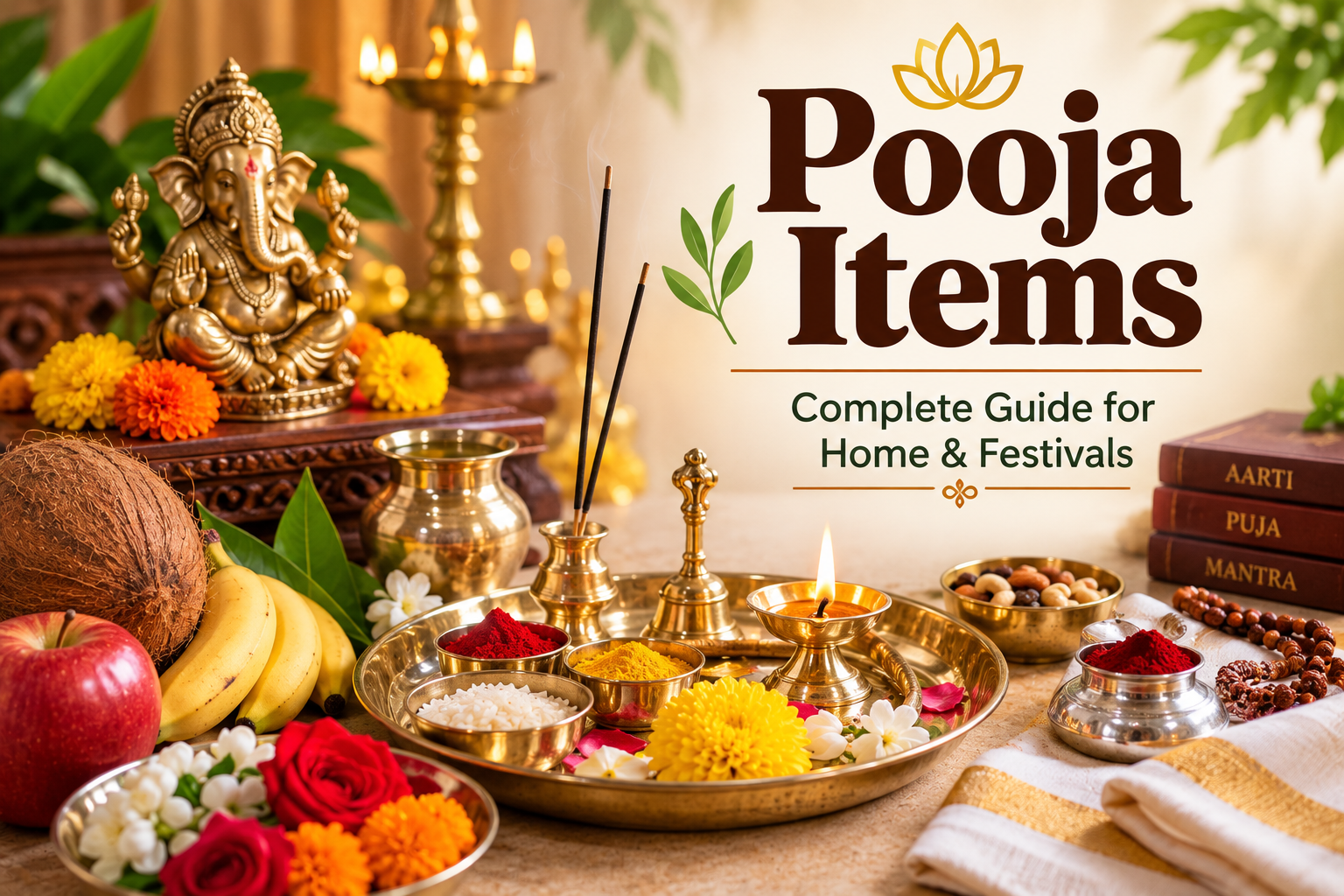
Setting up a home mandir or preparing for a Hindu puja often starts with one simple question: What pooja items do I actually need? The answer depends on the type of puja, the deity being worshipped, family traditions, and the specific ritual being followed. A simple daily puja may need only a few basic items, while festivals, havans, weddings, housewarming ceremonies, and special pujas may require a much longer list.
This complete pooja items list covers the commonly used Hindu puja samagri for a home mandir, explains what each item is used for, and separates everyday essentials from items needed for specific ceremonies.
If you live in the USA and are looking for pooja items, puja samagri, or Hindu prayer essentials, this guide can also help you create a shopping checklist before your next puja.
Pooja items, also called puja samagri, are the materials, utensils, offerings, and accessories used during Hindu worship and religious ceremonies.
Some items are used for daily prayer, such as a diya, incense, flowers, water, and an offering. Others are associated with particular rituals, festivals, or traditions.
There is no single pooja items list that applies to every Hindu family. For example, the items needed for Ganesh Puja can differ from those used for Lakshmi Puja, Shiv Puja, Satyanarayan Puja, Navratri, Diwali Puja, or a havan.
For this reason, it is useful to have a basic collection of puja essentials for home and then add ceremony-specific items when needed.
Here are some of the most commonly used Hindu puja items for a home mandir.
A diya is one of the most familiar items used during Hindu puja.
It is traditionally lit during prayer and aarti. Diyas may be made from clay, brass, copper, silver, or other materials.
For regular home worship, you can keep one or more diyas along with suitable oil or ghee and cotton wicks.
Cotton wicks are used with diyas and traditional oil lamps.
Keep a small supply of wicks at home so you can light the diya whenever you perform daily puja or aarti.
Oil or ghee is used to light the diya.
Common choices include sesame oil, mustard oil, or ghee, depending on family practice and the particular puja.
Agarbatti, also known as incense sticks, is commonly used during puja.
Sandalwood, jasmine, rose, and other fragrances are popular choices. Some households also use dhoop or other traditional incense products.
Camphor is commonly used during aarti.
A small amount is placed in an aarti holder or diya and lit as part of the prayer ritual.
Kumkum is commonly used for applying a tilak and for various Hindu religious rituals.
It is often kept alongside turmeric and other puja essentials.
Haldi is an important traditional ingredient used in many Hindu ceremonies.
It may be used during worship, applied to certain ritual items, or included in offerings depending on the puja.
Unbroken rice grains, commonly called akshat, are used in many Hindu rituals.
Rice may be offered during puja or used during specific steps of the ceremony.
Some families prepare akshat by mixing rice with turmeric.
Chandan, or sandalwood paste, may be used for applying tilak and during deity worship.
It is commonly kept as part of a traditional puja setup.
Fresh flowers are commonly offered during Hindu worship.
The type of flower can depend on the deity, festival, and family tradition. Fresh flowers can also be used to decorate the home mandir.
Flower garlands may be used to decorate idols and pictures of deities.
A garland can be particularly useful during festivals, special pujas, and celebrations.
Fresh fruits are commonly offered as naivedya during puja.
Bananas, apples, oranges, coconuts, and seasonal fruits are common choices, although the offerings can vary according to the occasion.
A coconut, often called nariyal, is used in many Hindu rituals.
It may be placed on or near a kalash or used as an offering, depending on the ceremony.
Betel leaves, or paan, and betel nuts, commonly called supari, are used in several traditional Hindu ceremonies.
They are particularly common in more elaborate pujas and ceremonial offerings.
A kalash is a traditional ritual vessel that may be filled with water and used during puja.
A kalash is commonly decorated with items such as mango leaves and a coconut, depending on the ritual.
Fresh mango leaves are traditionally used with a kalash and in certain ceremonial decorations.
Availability can depend on location and season, which can be an important consideration for families performing traditional ceremonies outside India.
A puja thali is a plate or tray used to organize puja materials.
It can hold items such as kumkum, turmeric, rice, flowers, diya, incense, and other small offerings.
A compartment-style thali can be particularly convenient because it keeps multiple items organized in one place.
A small bell, or ghanti, is commonly used during Hindu worship.
It is often rung at particular points during puja and aarti according to the family's or tradition's practice.
A shankh, or conch shell, is used in many Hindu traditions.
Depending on the ritual, it may be blown or used as part of the worship setup.
A panchapatra is a small vessel traditionally used to hold water during puja, while its accompanying spoon is used to handle the water during ritual steps.
These are more useful for households that regularly perform traditional puja procedures.
You don't need every possible puja item for a simple daily prayer.
A practical daily puja setup can include:
Deity idol or picture
Diya
Cotton wicks
Oil or ghee
Agarbatti or incense
Camphor
Kumkum
Turmeric
Rice or akshat
Fresh flowers
Water
Fruits or another food offering
Puja thali
Bell
This basic setup can be expanded depending on your family tradition and the type of worship you follow.
A special puja may require additional materials.
Depending on the ceremony, you may need:
Kalash
Coconut
Mango leaves
Betel leaves
Betel nuts
Flowers and garlands
Fruits
Dry fruits
Kumkum
Turmeric
Rice
Chandan
Camphor
Incense
Cotton wicks
Diya
Ghee or oil
Sacred thread
Coins
Cloth for the deity
Puja utensils
Havan samagri
The exact list should always be checked against the specific puja instructions because requirements can vary significantly between ceremonies.
If you are setting up a new home mandir, start with the basics rather than buying everything at once.
A practical home mandir can include:
Deity idol or framed picture
Puja chowki or clean platform
Puja cloth
Diya
Incense holder
Bell
Puja thali
Flowers
Water
Fruits
Rice
Kumkum
Turmeric
Chandan
Camphor
Aarti diya
Cotton wicks
Ghee or oil
Aarti plate
This gives you a practical foundation for everyday worship.
Ganesh Puja may include many of the standard puja essentials along with offerings traditionally associated with Lord Ganesha.
Commonly used items can include:
Lord Ganesha idol or picture
Diya
Incense
Flowers
Durva grass
Modak or other sweets
Fruits
Coconut
Kumkum
Turmeric
Rice
Chandan
Camphor
Water
Puja thali
Specific requirements may differ according to the regional and family tradition being followed.
Lakshmi Puja, particularly during Diwali, may require a combination of general puja essentials and festival-specific offerings.
Common items include:
Goddess Lakshmi idol or picture
Lord Ganesha idol or picture
Diya
Cotton wicks
Oil or ghee
Flowers
Lotus flowers where available
Kumkum
Turmeric
Rice
Fruits
Sweets
Coconut
Coins
Kalash
Mango leaves
Incense
Camphor
If you are following a specific Lakshmi Puja procedure, use the samagri list provided with that ritual.
A havan, also called homa or homam in different traditions, requires a different set of materials because offerings are made into a sacred fire.
Depending on the ceremony, commonly used items may include:
Havan kund
Havan samagri
Wood or samidha
Ghee
Camphor
Cotton wicks
Rice
Sesame seeds
Barley
Dry coconut
Jaggery
Flowers
Water
Kalash
Mango leaves
The exact materials and quantities depend on the specific havan being performed.
For Hindu families living in the USA, finding traditional puja supplies can sometimes require planning, especially for ceremonies that call for fresh or region-specific items.
A practical approach is to divide your shopping list into three groups.
These can generally be purchased ahead of time:
Kumkum
Turmeric
Rice
Incense
Camphor
Cotton wicks
Chandan
Sacred thread
Puja utensils
Havan samagri
These are better purchased closer to the ceremony:
Flowers
Fruits
Coconut
Fresh mango leaves
Betel leaves
Other fresh offerings
These should be checked against the exact puja instructions:
Special leaves
Specific flowers
Deity-specific offerings
Havan materials
Festival-specific items
Special cloth or ornaments
This approach can make preparing for a puja much easier when you're shopping in the USA.
If you're building your home puja collection from scratch, you don't need to purchase everything immediately.
Start with:
Diya
Cotton wicks
Ghee or oil
Incense
Camphor
Kumkum
Turmeric
Rice
Flowers
Puja thali
Bell
Chandan
A small water vessel
Fruits or other offerings
You can then add a kalash, shankh, panchapatra, special utensils, and ceremony-specific samagri as your needs grow.
Keeping puja supplies organized makes daily worship easier.
Store dry items such as kumkum, turmeric, rice, camphor, incense, and cotton wicks in clean, dry containers.
Keep puja utensils together so you don't have to search for them before every prayer.
Fresh flowers, fruits, leaves, and other perishable offerings should be purchased closer to the time they are needed.
A dedicated drawer, cabinet, or small storage box near the home mandir can help keep frequently used items together.
Use this checklist before your next puja:
| Pooja Item | Daily Puja | Special Puja |
|---|---|---|
| Diya | Y | Y |
| Cotton Wicks | Y | Y |
| Oil/Ghee | Y | Y |
| Incense | Y | Y |
| Camphor | Y | Y |
| Kumkum | Y | Y |
| Turmeric | Optional | Optional |
| Rice/Akshat | Optional | Optional |
| Flowers | Optional | Y |
| Fruits | Optional | Y |
| Coconut | Optional | Y |
| Kalash | Optional | Y |
| Mango Leaves | Optional | Often |
| Betel Leaves | Optional | Often |
| Betel Nut | Optional | Often |
| Bell | Optional | Optional |
| Shankh | Optional | Optional |
| Puja Thali | Y | Y |
| Havan Samagri | No | Havan only |
No. A long pooja samagri list should not be treated as a universal requirement.
The correct items depend on the specific puja, deity, tradition, and instructions being followed. A simple daily prayer can be performed with a small set of essentials, while a formal ceremony may require many additional materials.
If a priest, temple, family elder, or specific puja guide provides a samagri list, follow that list for the ceremony.
Preparing for a puja or festival? Vraj Fresh brings Indian grocery essentials like fruits, coconut, rice, dry fruits, spices, and sweets right to your doorstep in the USA.
Having a clear pooja items list makes it easier to prepare for daily worship, festivals, and special Hindu ceremonies. Start with a basic set of essentials for your home mandir and add ceremony-specific samagri when needed.
For families in the USA, planning ahead can be especially useful for fresh flowers, leaves, coconuts, and other items that may be less convenient to find at short notice.
Most importantly, remember that there is no single list that applies to every Hindu puja. Your family tradition, regional practice, deity, and specific ceremony should guide the final puja samagri list.
Basic home pooja items commonly include a deity idol or picture, diya, cotton wicks, oil or ghee, incense, camphor, kumkum, turmeric, rice, flowers, water, and an offering such as fruit or sweets.
A pooja samagri list can include items such as diya, wicks, incense, camphor, kumkum, turmeric, rice, flowers, fruits, coconut, kalash, mango leaves, betel leaves, betel nuts, chandan, and ritual utensils. The exact list depends on the puja.
For a home mandir, start with a deity idol or picture, diya, wicks, oil or ghee, incense, puja thali, kumkum, turmeric, rice, flowers, water, and a small offering.
Common Hindu puja essentials include light, water, flowers, food offerings, incense or fragrance, rice, kumkum, turmeric, and basic ritual utensils. Specific traditions may require additional items.
Ganesh Puja commonly uses a Ganesha idol or picture, diya, incense, flowers, durva grass, fruits, coconut, sweets or modak, kumkum, turmeric, rice, chandan, camphor, and water.
Lakshmi Puja commonly includes a Lakshmi idol or picture, Ganesha idol or picture, diya, flowers, kumkum, turmeric, rice, fruits, sweets, coconut, coins, incense, camphor, and other items depending on the specific puja procedure.
If you are preparing for a puja in the USA, start with shelf-stable essentials such as kumkum, turmeric, rice, incense, camphor, cotton wicks, chandan, and puja utensils. Purchase fresh flowers, fruits, leaves, and coconut closer to the ceremony.
The requirements vary by tradition and ceremony. A simple home prayer may use only a few basic items, while a formal puja can have specific requirements. If you are following a particular ritual, use the instructions provided for that ceremony.
“Pooja items” and “pooja samagri” are often used interchangeably. Pooja samagri generally refers to the collection of materials and offerings required for a particular Hindu worship ritual.


