


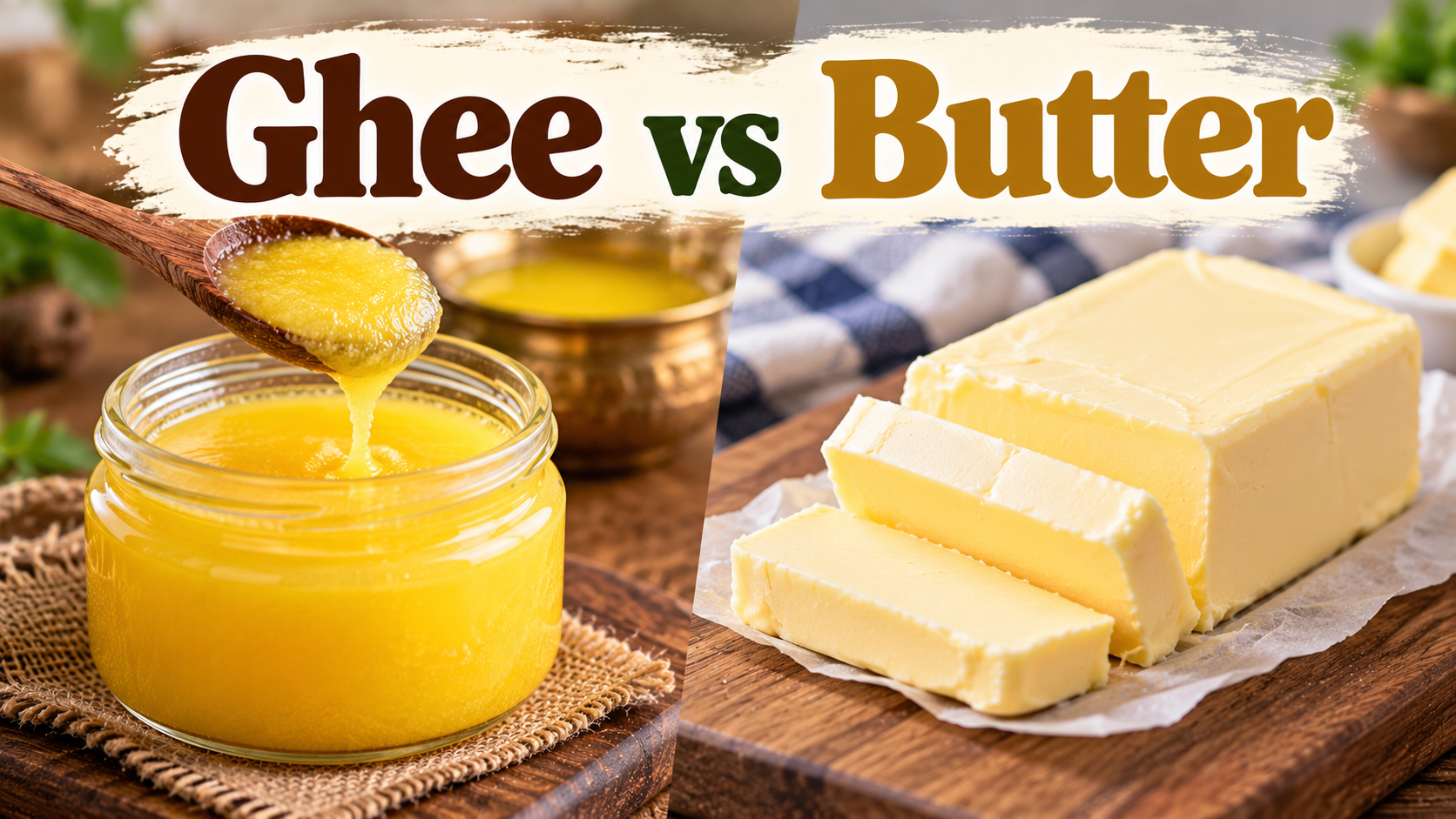
Ghee and butter are two popular dairy fats found in kitchens around the world. They look similar, but their composition, flavor, cooking performance, and nutritional profile are slightly different. So, which one should you choose?
Ghee or butter?
The answer depends on what you are looking for. Ghee is more concentrated and works particularly well for high-heat cooking, while butter has a creamy flavor and is widely used for baking, spreading, and everyday cooking.
When it comes to health, neither should automatically be considered the winner. Both are calorie-dense and contain significant amounts of saturated fat, so the amount you consume and your overall diet matter.
Let's compare them in detail.
Ghee is made by heating butter and separating its water and milk solids from the butterfat.
The result is a golden, aromatic fat with a rich and slightly nutty flavor.
Ghee is especially popular in Indian cuisine and is commonly used for:
Dal and khichdi
Roti and paratha
Pulao and rice dishes
Curries
Tadka
Sautéing vegetables
Indian sweets
Frying and roasting
Because most of the water and milk solids are removed, ghee is more concentrated than regular butter.
Butter is made by churning cream until the fat separates from the liquid portion.
It has a creamy texture and rich dairy flavor and is commonly used for:
Toast
Baking
Cookies and cakes
Sauces
Pancakes
Mashed potatoes
Cooking vegetables
Spreading on bread
Unlike ghee, butter still contains water and milk solids.
Both foods are primarily sources of fat, but their nutritional values are not identical.
A typical tablespoon of ghee provides around 120 calories, while a tablespoon of butter provides around 100 calories. Ghee also generally contains slightly more total fat and saturated fat per tablespoon because it is more concentrated.
| Nutrient | Ghee, 1 tbsp | Butter, 1 tbsp |
|---|---|---|
| Calories | ~120–123 | ~100–102 |
| Total fat | ~14 g | ~11–12 g |
| Saturated fat | ~9 g | ~7 g |
| Protein | Trace | Trace |
| Carbohydrates | Trace | Trace |
Exact values vary by brand and serving size, so check the nutrition label when comparing specific products.
The main reason is water.
Butter contains some water and milk solids, whereas ghee has most of these removed during clarification. That leaves a more concentrated fat.
This is why a tablespoon of ghee can provide slightly more calories than the same volume of butter.
Ghee generally has more calories per tablespoon than butter.
The difference isn't enormous, but it can matter if you use large quantities.
For example, adding one teaspoon to a meal is very different from adding several tablespoons throughout the day.
If you're trying to manage your calorie intake, focus on how much you use, not just which one you choose.
Neither ghee nor butter directly causes weight loss.
Both are calorie-dense foods, so eating large amounts can make it easier to consume more calories than your body needs.
You can still include either one in a weight-management diet. The key is portion control and the overall quality of your diet.
For example, using a small amount of ghee to flavor dal, vegetables, or roti can fit into a balanced meal.
Bottom line: Neither has a special weight-loss advantage. Your total calorie intake and overall eating pattern matter much more.
Both ghee and butter contain substantial amounts of saturated fat.
Ghee generally provides slightly more saturated fat per tablespoon because it is more concentrated.
Saturated fat is one reason both foods are best consumed in moderation, particularly for people who need to manage LDL cholesterol.
The American Heart Association recommends limiting saturated fat and replacing some saturated-fat sources with unsaturated fats from foods such as nuts, seeds and liquid plant oils.
This is an important point: switching from butter to ghee does not automatically turn a meal into a heart-healthy meal.
Both ghee and butter contain saturated fat, and both can contribute to dietary cholesterol intake.
However, the bigger nutritional consideration is often the overall pattern of fats in your diet.
If you regularly consume large amounts of ghee, butter, cheese, cream, coconut oil, or other foods high in saturated fat, simply switching between ghee and butter may not make a major difference.
For a heart-conscious eating pattern, replacing some saturated fats with unsaturated fats is generally a more useful strategy. The American Heart Association's 2026 dietary guidance continues to emphasize overall dietary patterns and choosing unsaturated fats in place of saturated fats.
This is where the two really differ.
Ghee is particularly useful for higher-temperature cooking because removing the milk solids gives it a higher smoke point than butter.
You can use it for:
Sautéing
Roasting
Stir-frying
Tempering spices
Pan-frying
Indian curries
Cooking vegetables
It also adds a distinctive nutty aroma to food.
Butter is excellent when you want its creamy dairy flavor.
It works especially well for:
Toast
Pancakes
Sauces
Vegetables
Mashed potatoes
Baking
Lower-temperature cooking
So, from a culinary perspective, ghee has an advantage for high-heat cooking, while butter has an advantage when you want its characteristic creamy flavor.
For most traditional baking recipes, butter is usually the easier choice.
Butter contains both fat and water, and that combination affects the structure, moisture, texture, and browning of baked goods.
Ghee can be used in some baking recipes, but because it contains much less water, it can produce a different texture.
If a recipe specifically calls for butter, replacing it with ghee may require adjustments.
Following a traditional cake recipe
Making cookies
Preparing pastries
Making buttercream
You want a classic buttery flavor
You want a richer, nuttier flavor
The recipe is designed for ghee
You're making certain Indian sweets or baked foods
For Indian cooking, ghee is often the more natural choice.
Its rich aroma works particularly well with spices and traditional dishes.
You can use ghee for:
Butter is also widely used in Indian cuisine, particularly in dishes where a creamy or buttery flavor is desired.
Both work well on roti.
If you want a rich, nutty flavor, ghee is a great choice.
If you prefer a creamy, mild dairy flavor, butter works well.
However, if you're watching calories, the amount matters more than the choice.
A thin layer of either is very different from adding several spoonfuls.
Some people find ghee easier to tolerate than butter because most of the milk solids have been removed.
Ghee contains very little lactose compared with regular butter, but it should not automatically be considered dairy-free.
People with a milk allergy should be particularly careful because ghee is still made from milk.
Also, lactose intolerance and milk allergy are different conditions. If you have a diagnosed dairy or milk allergy, speak with a healthcare professional before assuming ghee is safe.
Ghee contains very little lactose because the milk solids are largely removed during the clarification process.
However, ghee is still a dairy-derived product.
So it's more accurate to describe it as very low in lactose rather than simply calling it dairy-free.
If you have a milk allergy or significant dairy sensitivity, check with a healthcare professional before consuming it.
Taste is one of the easiest differences to notice.
Ghee generally has:
Nutty flavor
Rich aroma
Slightly roasted taste
Deep buttery notes
Butter generally has:
Creamy flavor
Mild dairy taste
Rich mouthfeel
Slight sweetness
Your choice can therefore depend entirely on the dish you're preparing.
This is where things get more nuanced.
It's tempting to label ghee as the “healthy” option and butter as the “unhealthy” one, but nutrition isn't that simple.
Both are calorie-dense and high in saturated fat.
Ghee has some practical advantages, such as its suitability for high-heat cooking and its very low lactose content.
Butter has advantages in baking, spreading, and recipes where its water and milk solids contribute to texture.
From a heart-health perspective, neither should replace healthier unsaturated fat sources simply because it is considered more natural or traditional. The American Heart Association recommends limiting saturated fat and choosing unsaturated fats more often.
Here's a simple way to decide:
| If you want... | Choose |
|---|---|
| High-heat cooking | Ghee |
| Rich Indian flavor | Ghee |
| Nutty aroma | Ghee |
| Very low lactose | Ghee |
| Baking | Butter |
| Toast and spreading | Butter |
| Creamy dairy flavor | Butter |
| Slightly fewer calories per tablespoon | Butter |
| Weight loss | Either, in moderation |
| Lower saturated fat | Neither is a clear winner |
Choose ghee for cooking and traditional Indian dishes.
Choose butter for baking, spreading, and creamy flavor.
For overall health, use both in moderation and prioritize unsaturated fats as your main everyday cooking fats when appropriate.
You don't necessarily need to completely avoid either food.
What matters is how much you consume and what the rest of your diet looks like.
If your meals already contain several sources of saturated fat, adding large amounts of ghee or butter can significantly increase your overall intake.
A better approach is to:
Use smaller portions
Measure cooking fats when needed
Eat plenty of vegetables and fruits
Include beans, lentils, nuts and seeds
Choose whole grains more often
Use unsaturated plant oils regularly
Keep highly processed foods limited
The American Heart Association emphasizes the overall dietary pattern rather than focusing on one individual food.
False.
Ghee is calorie-dense and actually contains slightly more calories per tablespoon than butter.
False.
Ghee does not directly burn fat or cause weight loss. Portion size and total calorie intake matter.
False.
Ghee is made from butter and is still a dairy-derived product.
Not necessarily.
Butter can fit into a balanced diet when consumed in appropriate portions.
Not necessarily.
Ghee has certain cooking advantages, but it is still a concentrated source of fat and saturated fat.
There isn't one amount that is appropriate for everyone.
Your needs depend on your total calorie intake, dietary pattern, activity level, health conditions, and the other fats you consume.
Instead of treating ghee or butter as unlimited “healthy fats,” think of them as flavorful, calorie-dense ingredients.
A small amount can add plenty of flavor to a meal.
If you have high LDL cholesterol, cardiovascular disease, diabetes, or another condition affected by dietary fat, discuss your individual intake with your healthcare professional.
| Category | Better choice |
|---|---|
| High-heat cooking | Ghee |
| Indian cooking | Ghee |
| Nutty flavor | Ghee |
| Baking | Butter |
| Spreading | Butter |
| Lower calories per tablespoon | Butter |
| Weight loss | Either in moderation |
| Low lactose | Ghee |
| Saturated fat | Neither |
| Overall health | Depends on portion and dietary pattern |
So, ghee or butter—which one is better?
There isn't one universal winner.
Ghee is a great option when you want a concentrated cooking fat with a rich, nutty flavor, particularly for Indian cooking and higher-heat applications.
Butter is an excellent choice when you want a creamy dairy flavor, especially for baking and spreading.
From a health perspective, both should be enjoyed in reasonable portions because they are calorie-dense and high in saturated fat.
Rather than asking whether ghee or butter is “healthy,” a better question is:
How much am I using, what am I using it for, and what does the rest of my diet look like?
That approach gives you much more flexibility while keeping your overall diet balanced.
Vraj Fresh makes it easy to find Indian grocery essentials and pantry staples in the USA for everyday cooking, traditional recipes, snacks, sweets, and more.
Ghee generally has slightly more calories per tablespoon because it is more concentrated in fat.
Ghee generally contains slightly more saturated fat per tablespoon than butter.
Neither is specifically better for weight loss. Both are calorie-dense, so portion size and your overall calorie intake matter more.
Yes, ghee can replace butter in many cooking applications. However, it may change the texture of baked goods because ghee contains much less water than butter.
Yes. Ghee is generally better suited to high-heat cooking than butter because the milk solids have been removed.
No. Ghee is made from butter and is still a dairy-derived product, although it contains very little lactose.
Butter isn't automatically “bad,” but it is high in calories and saturated fat. Moderation is important, particularly if you are trying to limit saturated fat.
Ghee can be included in a balanced diet, but portion size matters because it is calorie-dense and high in saturated fat.
Ghee is often preferred for Indian cooking because of its rich, nutty flavor and suitability for sautéing, tempering, roasting, and other cooking methods.
Butter is generally the easier choice for traditional baking because its water and milk solids contribute to the texture and structure of many baked goods.


